
Grok AI
Grok AI Review: The Unfiltered, Real-Time Truth-Seeking AI in 2026
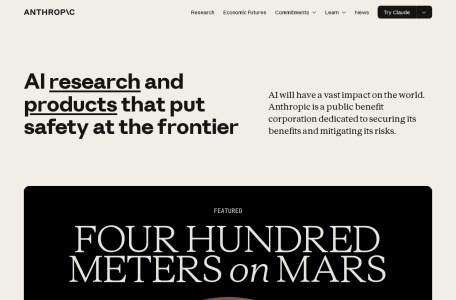
Anthropic Review: The Safety-First Frontier AI Behind Claude in 2026
 Anthropic
Quick Verdict:
Expert Rating: 4.8 out of 5.0
Best For: Developers, researchers, enterprises, and professionals prioritizing ethical alignment, reliable reasoning, advanced coding/agentic tasks, and long-context analysis
Bottom Line: Anthropic leads in 2026 with Claude’s Opus 4.6 and Sonnet 4.6 delivering unmatched safety, coding mastery, and agentic reliability—making it a premier choice if trustworthy, high-stakes AI assistance is your priority over raw speed or broad multimodality.
Introduction:
Concerned about AI hallucinations, biased outputs, or tools that prioritize flash over reliability in critical work like coding, research, or decision-making? Many professionals hesitate to trust frontier AI for high-stakes tasks due to safety gaps and inconsistent performance. Anthropic addresses this directly in this Anthropic review. As the company behind Claude, it focuses on Constitutional AI for ethical, steerable intelligence with models like Opus 4.6 (flagship for complex reasoning and coding) and Sonnet 4.6 (balanced powerhouse). Features include massive 1M token context (beta), sustained agentic workflows, and strong safeguards—ideal for dependable, thoughtful AI use. Let’s assess if Anthropic’s approach makes Claude worth your investment in 2026.
Key Features:
– Claude Opus 4.6 Flagship Model: World’s leading model for coding, agents, and professional work—excels at careful planning, long-horizon tasks, large codebases, self-debugging, and deep reasoning with 1M token context (beta) for handling vast inputs reliably.
– Claude Sonnet 4.6 Balanced Model: Most capable Sonnet yet with frontier-level performance in coding, computer use, agent planning, knowledge work, and design—offers 1M token context (beta) and improved consistency at accessible speeds.
– 1M Token Context Window (Beta): Enables processing enormous documents, codebases, or threads without “context rot”—maintains high performance on long inputs for real-world complex projects.
– Agentic & Computer Use Capabilities: Sustains autonomous multi-step tasks, tool chaining, and virtual computer control—boosts productivity in software engineering, analysis, and workflows.
– Ethical Constitutional AI & Safety Focus: Built-in safeguards minimize risks, hallucinations, and misalignment—aligns outputs with user values and Anthropic’s Responsible Scaling Policy for trustworthy use.
– Claude Code & Cowork Tools: Autonomous coding agent for generation/debugging/review; Cowork interface for prototyping and project organization—dramatically enhances developer efficiency.
– Integrations & Connectors: Slack, Google Workspace, Excel, PowerPoint, and MCP for external tools/data—seamless chaining in professional environments.
– Extended Thinking & Research Modes: Step-by-step reasoning on demand for tougher problems; web search and file analysis for accurate, in-depth responses.
How It Works:
1. Visit claude.ai (or anthropic.com for API) and sign up/log in—start free on web, iOS, Android, or desktop without a card.
2. Enter your query or upload files (e.g., “Debug this large codebase” or “Analyze this report with extended thinking”).
3. Claude selects the optimal model (e.g., Opus 4.6 for depth); it reasons step-by-step, plans agentically, or executes code autonomously.
4. Refine via follow-ups; memory and projects keep context across sessions for ongoing work.
5. Upgrade to Pro/Max for higher limits, full Opus 4.6 access, priority features, and advanced tools like Claude Code/Cowork.
Pros & Cons Table:
Pros:
– Industry-leading safety and ethical alignment reduce risks in professional use
– Opus 4.6 and Sonnet 4.6 top benchmarks in coding, agents, and long-context reasoning
– Massive 1M token context handles real-scale projects without performance drop
– Strong agentic capabilities for autonomous, reliable task execution
– Transparent scaling policy and safety research build long-term trust
Cons:
– Free tier limits heavy usage and advanced model access
– Higher tiers (Max from $100/month) expensive for non-power users
– Less native focus on creative multimodal generation (e.g., video) vs some rivals
Pricing & Plans:
Freemium with Free (access to capable models like Sonnet 4.6 default, limits apply). Pro ($20/month or $17/month annually billed at $200/year—more usage, all models incl. Opus 4.6, priority, unlimited projects, Claude Code/Cowork). Max (from $100/month per person—5x+ usage over Pro, early features, higher limits). Team (around $25–$30/user/month) and Enterprise (custom, often $60+/seat/month with security/compliance). API pay-as-you-go (e.g., Opus 4.6 $5/$25 per million input/output tokens; premium for >200k context or fast modes).
Top 5 Alternatives:
– ChatGPT (OpenAI): Versatile multimodal leader with strong voice/research—great for broad creative or casual needs.
– Google Gemini: Excellent Google Workspace integration and real-time multimodal—ideal for ecosystem users needing personalized tools.
– Grok (xAI): Uncensored, real-time X insights with witty style—solid for exploratory or less-filtered conversations.
– Perplexity AI: Research specialist with cited sources and agents—perfect when transparency and fact-checking are key.
– Microsoft Copilot: Deep Microsoft 365 ties—top for Office-centric productivity and enterprise workflows.
FAQ (Schema Ready):
Is Anthropic’s Claude the safest AI in 2026?
Yes, its Constitutional AI and Responsible Scaling Policy deliver highly aligned, low-risk outputs—often preferred for ethical, professional, or high-stakes applications.
How much does Anthropic Claude cost in 2026?
Free tier available; Pro $20/month ($17 annually); Max from $100/month; Team ~$25–$30/user/month; Enterprise custom. API token-based (e.g., Opus 4.6 $5/$25 per million).
What models does Anthropic offer in 2026?
Latest include Claude Opus 4.6 (flagship reasoning/coding), Sonnet 4.6 (balanced frontier), and Haiku 4.5 (fast/efficient)—with 1M context beta on top tiers.
Is Claude Pro worth it in 2026?
Yes for regular users—unlocks full Opus 4.6 access, higher limits, Claude Code/Cowork, and priority features for major productivity gains.
What are the newest Anthropic features in 2026?
Opus 4.6 and Sonnet 4.6 upgrades with 1M context beta, enhanced agentic coding, Claude in PowerPoint/Excel, and continued safety advancements stand out.
In conclusion, this Anthropic review underscores its position as a top evaluation-stage option in 2026—its emphasis on safe, powerful frontier models like Claude Opus 4.6 makes it worth exploring (or subscribing to) for users seeking reliable, ethical AI over less guarded alternatives.